Hand Press
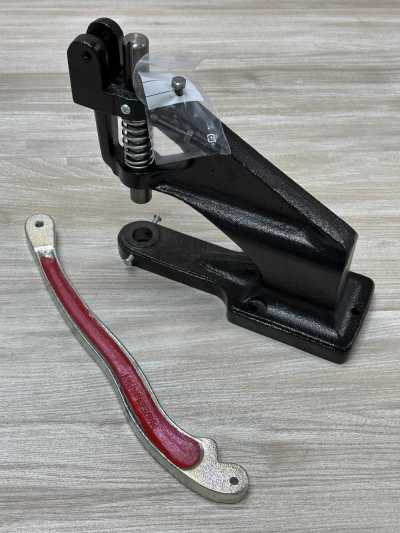
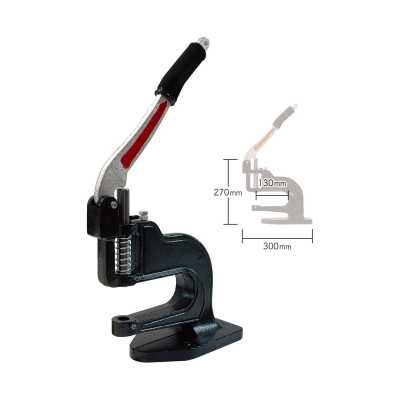
A hand press is a manual attachment tool that is operated by hand with a lever to apply pressure to the dies and attach press fasteners, eyelets, and cap and close posts to fabric.
Contents6 sections
Definition and Overview
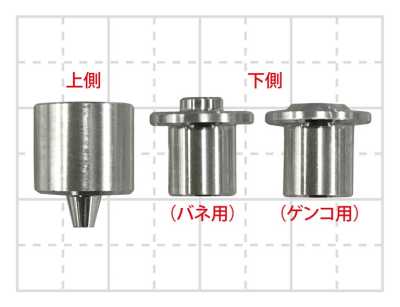
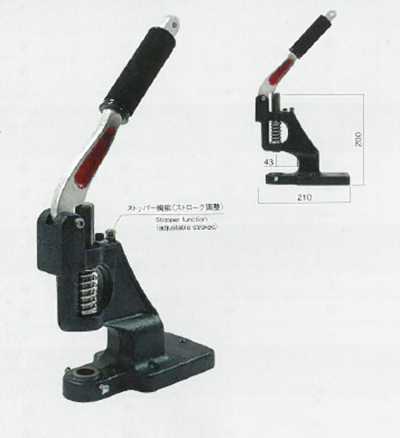
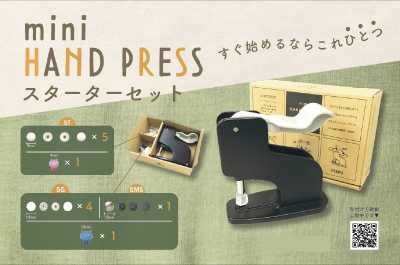
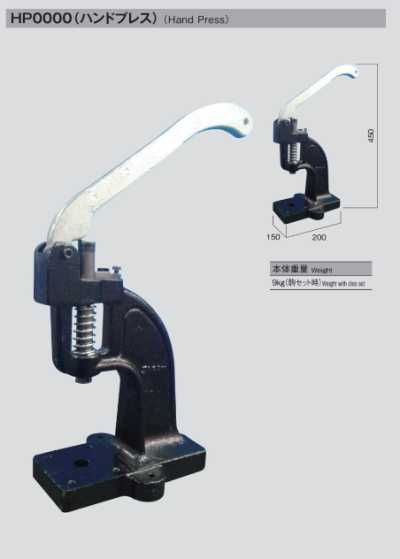
A hand press is a manual press machine used while fixed to a tabletop or similar surface. It clamps fittings between upper and lower dies attached to the main unit, and crimps the parts with pressure applied by lever operation. It is used for small-lot production, prototyping, and sample making.
It is not a term for the parts themselves, such as press fasteners or eyelets, but for the tool used to attach them. Because it is used according to the combination of dies and parts, the hand press main unit alone cannot attach all accessories.
Compatible Parts and Structure
A typical hand press consists of the main unit, lever, holding section that secures the upper and lower dies, and base. When the lever is lowered, the upper die descends and deforms and presses the part received by the die on the base side.
In many cases, a press fastener combines paired parts such as the cap, spring or stud, eyelet, and washer. Eyelets and cap and close posts are also attached using dedicated dies that match the shape and dimensions of the parts, in the configured combination.
- Press fastener: a metal or resin fastener with an opening and closing function.
- Eyelet: a ring-shaped fitting that reinforces and decorates the area around a hole.
- Cap and close post: a fitting used to press and secure multiple materials or parts together.
- Die: a matched pair of upper and lower tools used to shape and secure parts correctly.
How to Check Size
The suitability of a hand press is checked not only by the size of the main unit, but also by the specifications of the parts and dies used. For press fasteners, the outer diameter of the cap; for eyelets, the inner diameter, outer diameter, and leg length; and for cap and close posts, the head diameter and shaft length are among the items to check.
Even parts that appear to have the same nominal diameter may not share dies if the maker, series, or shape differs. It is important to manage the part name, product number, finish, size, and compatible dies as a set, and to perform trial fastening on the actual fabric to be used.
How to Attach and Main Applications
When attaching, check the front and back and the orientation of the parts, set them on the fabric, and operate the lever while aligning with the center of the die. If necessary, open a pilot hole with a hole punch, but depending on the part or fabric, some specifications allow attachment without punching a hole.
It is used for openings and reinforcement sections on outerwear, shirts, pants, bags, and fashion accessories. In mass production, press machines such as foot-operated or air-operated types may also be used, but a hand press does not take up much workspace and is suitable for work that involves changing product type or size.
Selection and Precautions
If the length of the fitting leg and the pressing force of the dies are not appropriate for the fabric thickness, density, stretch, and number of layers, pullout, looseness, deformation, and tearing of the fabric may occur. For thin fabrics or easily stretched knits, reinforcement with a pressing cloth or interlining should also be considered.
Stronger striking is not always better; excessive pressure can lead to cracking or deformation of the parts and damage to the coating or plating. Conduct tests assuming washing, friction, and tensile load, and if there are concerns about rust or discoloration, check the fitting material, surface treatment, and storage environment.
For products using metal parts, clearly specify in the specification sheet whether a needle detector compatible response is required. For applications that touch the skin, consider the effects of nickel, and share with the supplier whether a nickel-free specification is necessary, the scope covered, and the verification method.
Frequently Asked Questions
Do I need a hand press and dies separately?
In many cases, yes. The hand press is the main unit that applies pressure, and the actual shaping and fixing of the parts is done by a matched pair of upper and lower dies. Select dies that correspond to the type, size, and specification of the press fastener, eyelet, or cap and close post to be used.
Can a hand press attach press fasteners to thick fabrics?
This is determined not only by fabric thickness, but also by the combination of the number of layers, interlining, leg length of the part, and pressing conditions of the press. If the leg is too short, the part may not be crimped sufficiently; if it is too long, looseness may occur. Always verify with a trial fastening under the same conditions as mass production.
What should be checked after attaching a press fastener?
Check the front/back orientation, center misalignment, lifting of the part, deformation, holding force during opening and closing, and tearing or damage to the fabric. Depending on the product application, checking repeated opening and closing, tensile strength, and the condition after washing makes it easier to understand the risk of detachment or discoloration during use.