Placket
A placket is the reinforced, finished section set at the front opening of shirts, blouses, jackets, and similar garments, used to attach fasteners such as buttons and zippers.
Contents5 sections
Definition and Overview
A placket refers to the part that opens and closes at the center front of a garment, as well as the tailoring around it. In shirts, it often refers to the strip-shaped section where buttonholes and buttons are placed, and it is an important detail that provides ease of dressing while also affecting the product's appearance.
The width of the placket, the overlap direction, whether stitching is used, and the use of interlining are determined according to the item's applications, design, and the thickness and body of the fabric. It is used not only for shirts, but also for cardigans, polo shirts, jackets, workwear, and more.
Types and Differences from Similar Terms
An exposed placket is a specification in which the placket strip is visible from the outside on the front body. The vertical line serves as an accent and is used in casual shirts and uniforms. A concealed placket makes the strip less visible from the outside, creating a cleaner look.
A hidden button placket is a construction in which an extra flap covering the buttons or zipper is provided so the fastener is less visible from the surface. It may also be treated as a type of placket, but it differs from a standard exposed or concealed placket in the visibility and structure of the fastener.
A facing is the part used to finish and reinforce the front edge or neckline from the inside. It may be used for front openings, but its role differs from a placket, which has a fastening function such as buttons.
Production Process and Instructions
In the planning and pattern stages, specify the placket type, finished width, front-edge overlap, number and spacing of buttons, direction of buttonholes, and the area covered by interlining in the specification sheet. To avoid mixing up the left and right front panels, also specify left and right as seen by the wearer and the overlap direction.
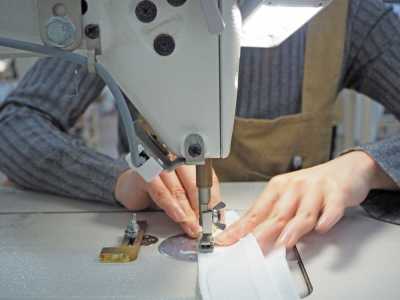
In sewing, the placket is made by folding after applying interlining, or by sewing together separately cut fabric pieces. Confirm that the grain is aligned and that the fold line is stable, and when stitching is used, standardize the distance from the edge and the appearance of the seam line.
Buttonholes and button attachment are performed after the placket is completed, once the positions have been confirmed. Checking the relationship with the collar area, hem, chest pocket, and pattern placement as well can help reduce shifting during wear and appearance defects.
- List the finished width, stitch position, interlining type, and application area in the specification sheet.
- In the final check, confirm front-edge waviness, twisting, left and right width, and button spacing.
- For stripes and checks, decide in advance the standard for pattern matching at the center front.
- For thick fabrics or stiff interlining, confirm the thickness at the buttonhole area and the ease of fastening and unfastening the button.
Ordering and Quality Considerations
A placket involves multiple materials and processes, including the outer fabric, fusible interlining, buttons, and thread for buttonholes. When placing a mass-production order, it is important to check the compatibility of the outer fabric and interlining, pressing conditions, and the difference in shrinkage after washing with samples in order to prevent front-edge warping and interlining bubbling.
With thin or stretchy fabrics, the placket is prone to stretching and waviness, so the choice of interlining and stay tape affects the finished result. With thick fabrics, pay attention to seam slippage caused by thickness differences and buttonhole defects, and coordinate the sewing machine and sewing procedure with the factory.
Frequently Asked Questions
What is the difference between a placket and a facing?
A placket is the section on the front opening that is fitted with buttons, buttonholes, and similar elements to open and close the garment. A facing refers to the fabric used to finish and reinforce the front edge or neckline from the inside. Buttons may be attached to a facing on a front opening, but the purpose and terminology are different.
How do you choose between an exposed placket and a concealed placket?
An exposed placket keeps the strip-like change visible, making it a specification that readily uses the vertical line as part of the design. A concealed placket makes the front edge look neat. Choose according to the fabric thickness, how you want the stitching to show, and the intended product style, such as casual or more dressy.
What causes a placket to wave?
The main causes are differences in shrinkage between the outer fabric and interlining, the stiffness of the interlining and application conditions, fabric stretch, and differences in feed during sewing. Before mass production, conduct tests with combinations of the outer fabric and interlining, and check the pressing conditions, grain direction, and the settings for presser pressure and feeding during sewing.