Anti-slippage Tape
Anti-slippage Tape is a reinforcing tape used on seam allowances and similar areas to prevent seam slippage, where warp and weft threads shift and create gaps when force is applied to a woven fabric seam.

Contents6 sections
Definition and Overview
Anti-slippage Tape is used on coarse weaves, low-density weaves, and fabrics made with slippery filament yarns to suppress yarn slippage near seams. Slippage is different from the fabric itself tearing; it is a state in which the warp and weft yarns pulled by the sewing thread move and the seam opens up visibly.
Where It Is Used and Its Role
It is used on seams that are subject to concentrated pulling during wear, such as pocket openings, side seams, crotch seams, center back seams, necklines, and armholes. By reinforcing the seam allowance side, it helps control fabric movement during sewing and makes it easier to maintain the seam’s appearance and durability.
With thin fabrics or slippery fabrics, yarn slippage may occur even if only the outer fabric is stitched firmly. By distributing the load with tape, it makes seam allowance tearing and seam opening less likely. However, it does not restore the strength of the fabric itself.
Types and Cutting Direction
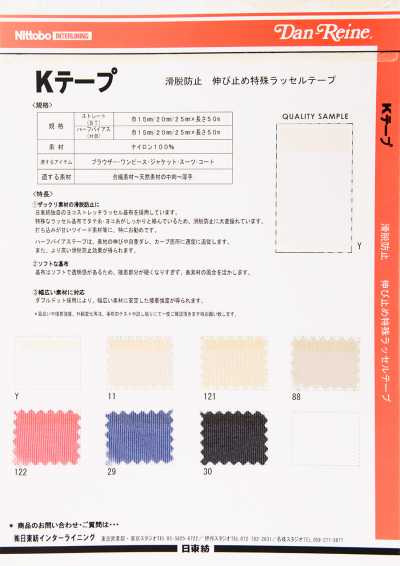
Tape includes straight-grain cut pieces, bias-cut pieces, and half-bias pieces with stretch between the two. Because stretch and conformity differ depending on the cutting direction, choose according to the shape of the area to be reinforced and the required elasticity.
Straight types are suited to linear areas where stretch should be suppressed. Bias types are easier to follow curves and are used for areas such as necklines and armholes that require moderate conformability. There are adhesive types with glue and non-adhesive types that are fixed by stitching, and they are used depending on the outer fabric and the process.
- Adhesive type: easy to temporarily fix and secure with an iron or press, helping stabilize the process.
- Non-adhesive type: considered for heat-sensitive materials or when you want to avoid changes in hand caused by adhesion.
- Straight type: suitable for areas where stopping stretch is the priority.
- Bias type: suitable for areas that need to follow curves and allow moderate stretch.
How to Choose and Precautions for Adhesion and Sewing
Choose the width by considering the seam allowance width, the distance from the seam to the tape edge, and the area that needs reinforcement. If the tape is too narrow, the reinforced area will be insufficient; if it is too wide, the seam allowance may become stiff or the surface may show fading. It is important to avoid anything that is extremely stiffer than the outer fabric.
For adhesive types, test the temperature, pressure, and time on a scrap of the outer fabric before use. Excessive heat or pressure can cause changes in hand, gloss, or adhesive bleed-through. During sewing, do not stretch the tape; sew the fabric and tape with the same feed rate to prevent seam puckering and waviness.
Differences from Similar Terms
Stay tape is a reinforcement material used to suppress yarn slippage that occurs at woven seams. Stretch prevention tape broadly refers to uses such as controlling stretch and shape distortion at shoulder seams and pocket openings, and may not have anti-slippage as its main purpose. Clarify the required performance in the specification sheet.
Non-slip elastic band is an accessory material used to prevent garments or straps from shifting on skin or over other clothing. In contrast, stay tape targets yarn movement within the fabric structure. The names are similar, but the uses, attachment positions, and required performance are different.
Frequently Asked Questions
What kinds of fabrics need stay tape?
It is considered for woven fabrics where warp and weft yarns are likely to move when force is applied to the seam. It can be especially effective for thin fabrics, open weaves, and slippery fabrics. However, necessity varies depending on fabric density, seam direction, ease allowance, and wearing conditions, so it should be checked with prototypes.
Are stay tape and stretch prevention tape the same?
They are sometimes treated as the same, but the performance emphasized is different. Stay tape mainly suppresses yarn slippage around seams. Stretch prevention tape mainly prevents fabric stretch and shape distortion, and is selected according to the area and the fabric issue.
What should be checked when using an adhesive type?
Before mass production, perform an adhesion test on scraps of the outer fabric and check adhesion strength, hand, gloss, bleed-through, and condition after washing. Also, in addition to press conditions, confirm whether the taped area does not show through on the right side as visible marks or fading.