Fusing Conditions
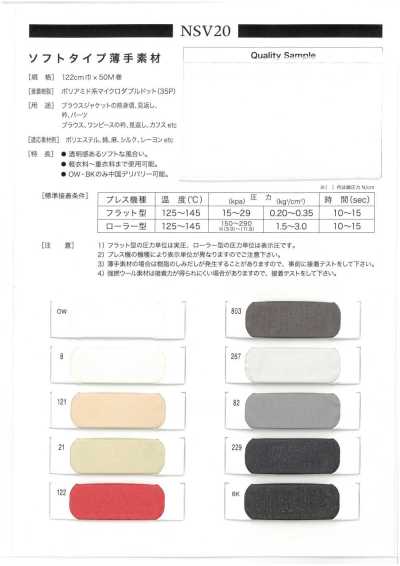
Fusing conditions are the temperature, pressure, time, cooling, and other settings and controls used when heat-bonding fusible interlining to the shell fabric in order to achieve proper adhesion and hand.
Contents6 sections
Definition and Overview
Bonding conditions are the process conditions used to fix fusible interlining, which has a heat-melt adhesive resin, to the outer fabric. They are mainly controlled by the press temperature, pressure, and pressing time, and sufficient cooling after bonding also affects the stability of the finish.
Even with the same fusible interlining, the suitable conditions vary depending on the outer fabric’s fiber, weave, thickness, finish, color, and other factors. It is important to use the recommended conditions shown in the interlining specification sheet as a baseline and to test them on the actual outer fabric before mass production.
- Temperature: the temperature of the press surface used to properly melt the adhesive resin.
- Pressure: the force that brings the interlining and outer fabric into close contact and helps the resin blend into the textile side.
- Time: the duration for applying temperature and pressure; too short or too long can both cause problems.
- Cooling: the process of stabilizing the resin after bonding; care is needed when handling it before it has fully cooled.
Areas Used and Their Role
Bonding conditions are managed when using fusible interlining in areas that need to hold their shape, such as collars, front plackets, cuffs, facings, pocket openings, and waist belts. Their role is to stabilize the required firmness, recovery, and ease of handling during sewing.
In jackets and coats, interlining may be fused over wide areas such as the front body and lapels. On the other hand, in thin shirts and blouses, it is necessary to prioritize preserving the softness of the outer fabric and avoid excessive heat and pressure.
Settings According to Interlining and Outer Fabric
Fusible interlining includes nonwoven interlining, woven interlining, and knit interlining, each with different base fabric elasticity, thickness, and adhesive resin type and application state. Therefore, even interlining with the same appearance cannot be bonded under a uniform set of conditions.
Regarding compatibility with the outer fabric, confirm the outer fabric’s thickness, firmness, elasticity, surface texture, brushed finish, water-repellent finish, and other treatments. For thin or heat-sensitive materials, be careful of shine and shrinkage, and for stretch materials, consider interlining and conditions that do not hinder the stretch of the outer fabric.
When selecting interlining, check not only the firmness after bonding but also the outer fabric’s hand, drape, and condition after washing. If the interlining is much firmer than the outer fabric, it may cause puckering around seams or an unnatural firmness.
Bonding and Sewing Precautions
If the temperature or time is insufficient, poor bonding or insufficient peel strength may occur. Conversely, if the conditions are too strong, adhesive bleed-through, shine on the outer fabric, shrinkage, discoloration, and a harder hand may result.
After bonding, do not judge only by appearance; check the bonded state including the edges, durability assuming washing or dry cleaning, and lifting when bent. Bubbling is a phenomenon in which lifting or a bubble-like appearance occurs between the outer fabric and the interlining, and it may be caused by unsuitable conditions or material incompatibility.
During sewing, pay attention to thickness differences between bonded and non-bonded areas, needle holes, and seam misalignment. Since the garment may be reheated during the pressing process after sewing, it is necessary to determine the conditions while considering the heat history of the entire process.
Differences from Similar Terms
Fusible interlining refers to the interlining itself, which is bonded to the outer fabric for reinforcement or shaping, while bonding conditions refer to the process settings for applying it. Haircloth interlining and non fusible interlining are often used with stitching or temporary holding, and their use differs from fusible interlining, which assumes heat bonding.
Peel strength is an evaluation item that shows how resistant the bonded interlining is to peeling away from the outer fabric. Bonding conditions affect peel strength, but the combination of interlining and outer fabric, the adhesive, and post-processing or washing conditions also affect the evaluation results.
Frequently Asked Questions
Is it fine to use the recommended values for the interlining as they are?
The recommended values are useful as a starting point for setting the conditions, but the finish changes depending on the combination with the outer fabric and the state of the press machine. Before mass production, perform trial bonding with the actual outer fabric and interlining, and determine the conditions by checking the appearance, hand, peeling, and post-wash condition.
How do you check bubbling, where the interlining lifts after bonding?
Observe the bonded surface on a flat area and shine light from an angle to check whether there is any localized lifting or waviness. Gently bending it by hand or checking the edges is also effective. If it occurs, review not only the temperature, pressure, and time, but also the compatibility between the outer fabric and the interlining.