Chemical Lace
Chemical lace is a lace with sheerness and dimensionality, made by embroidering a water-soluble foundation and then dissolving the foundation to leave only the embroidered thread pattern.
Contents6 sections
Definition and Overview
Chemical lace is a lace made by stitching a pattern with an embroidery machine onto a water-soluble base fabric, then removing the base. Because no net-like ground structure remains to support the pattern, it has the appearance of connected embroidery itself.
Guipure lace is a broad term for lace that has no ground mesh and connects motifs with bars or similar elements. Chemical lace is sometimes called guipure lace, but if you want to identify the manufacturing method, it should be distinguished as chemical lace.
How It Is Made and Materials
Generally, a continuous pattern is embroidered onto a water-soluble base using a multi-head embroidery machine or similar equipment, and the base is dissolved in a washing process. Each part of the pattern is structurally joined by embroidery thread or connecting thread, so the lace keeps its shape even after the base is gone.
Cotton, rayon, polyester, and other materials are used for the embroidery thread, and luster, firmness, and sheerness vary depending on the type of thread, thickness, and embroidery density. Even within chemical lace, stretch and ease of handling during washing differ depending on the composition and finish.
Visual Characteristics
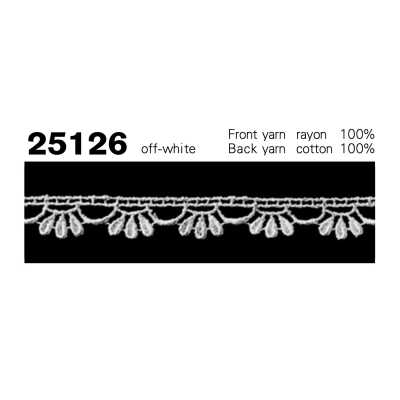
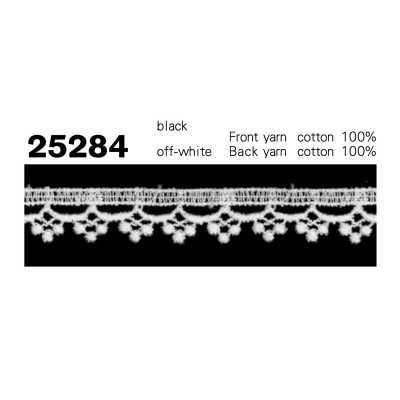
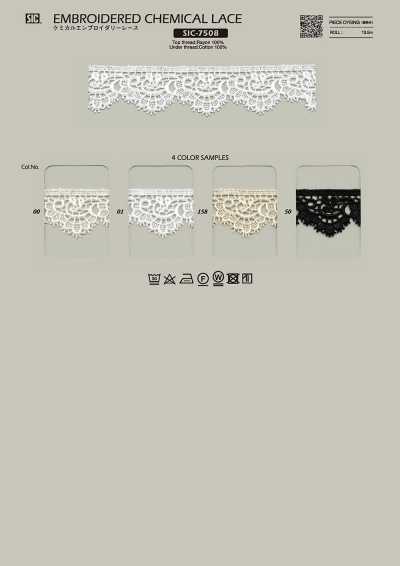
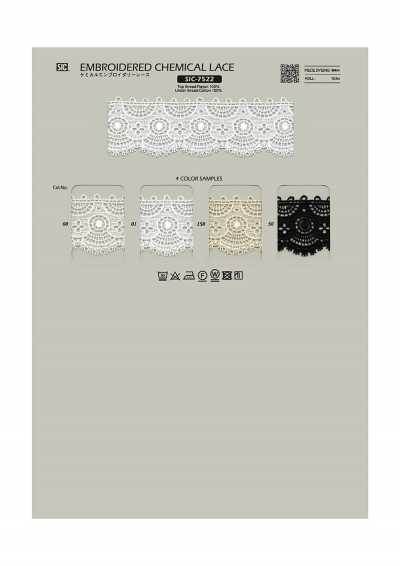
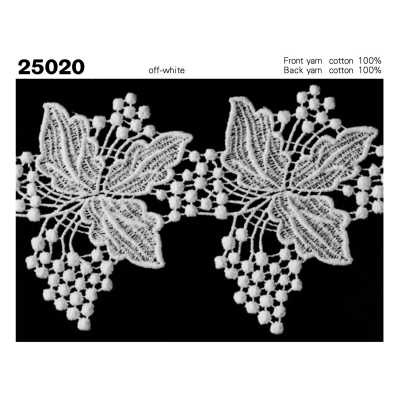
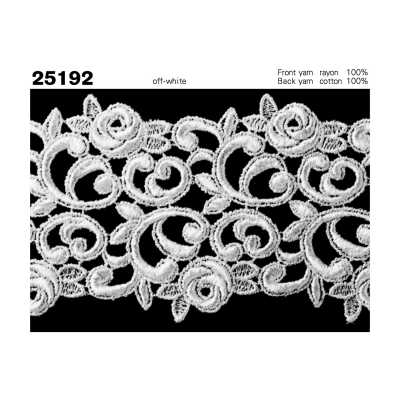
It is well suited to expressing floral and botanical patterns with clear outlines, and some designs incorporate thick thread that looks like cord or bold edging. Areas where the ground is removed are sheer, while the embroidered parts are dense, creating pattern shading and dimensionality.
Unlike lace that leaves a mesh ground in the background, such as tulle lace, one characteristic is that the cut-out areas are more visibly open. On the other hand, depending on how the motifs are connected and the embroidery density, it may feel heavier and stiffer than it looks.
Main Applications
It is used for decorating the bodice, sleeves, and hems of dresses, blouses, skirts, and other garments. Taking advantage of its ornate patterns and sheerness, it is also used for formal wear and stage costumes, as well as for partial switching details and lace tape.
Because it includes sheer sections, products are often designed with a combination of lining, separate fabric, tulle, and similar materials. For product numbers where the pattern edge can be used as a scallop, the cut edge of hems or cuffs can also be finished decoratively.
Selection and Handling Notes
When selecting, check the pattern size, embroidery density, width, selvedge specifications, and how the pattern edge will be used. If it will be used over a large area such as the bodice, it is easier to evaluate the finished result if you confirm the pattern placement, left-right symmetry, and appearance based on the cutting position in advance.
Because chemical lace has no ground structure, force concentrated on thin connecting sections or pattern edges can cause breaks or fraying. Stretch depends on the composition and pattern structure, so confirm the stretch in each direction of pull, and avoid excessive feeding or pulling during sewing.
Washing methods should be determined according to the composition and processing. To prevent snagging and loss of shape, using a laundry net, washing with gentle water flow, and flat drying may be suitable. Before mass production, conduct washing tests to check shrinkage, deformation, fraying, and color transfer.
Frequently Asked Questions
Are chemical lace and guipure lace the same?
Does chemical lace stretch?
Stretch is not uniform. If it uses yarn containing polyurethane or has a stretchy structure, it may stretch, but many chemical laces only show slight give from movement in the motif connections. Check the actual material in the lengthwise, widthwise, and bias directions, and reflect it in the pattern.
Do the cut edges of chemical lace fray?
If the thread connections in the embroidery are cut, the threads may unravel from the edge or the pattern may break. Use sections that can serve as finished edges, such as scallops, or consider a construction that allows seam allowance to be secured and sewn in. It is important to check edge finishing and strength with a cutting sample.
- Browse Chemical Lace products
- Products with material "Cotton"
- Products with material "Polyester"
- Products with material "Rayon"
- Products for style "For Shirts/blouses"
- Products for style "For Skirts And Dresses"
- Products for style "For Formal Wear"
- Products for style "For Costumes/dresses"
- Products for style "For Interiors"
- Browse Lace products