Ligne
Ligne is a traditional unit used mainly to indicate the outer diameter of buttons; 1 Ligne is equivalent to approx. 0.635 mm and is used for button size selection and in specifications.
Contents6 sections
Definition and Overview
Ligne is a unit used to indicate the size of apparel findings, including buttons. It comes from the French word Ligne, and the notation “L” or “ligne” is used. In Japan’s button industry, it is often used as the nominal outer diameter.
1 Ligne is 1/40 of an inch, or approx. 0.635 mm. Therefore, the larger the Ligne value, the larger the button diameter. In specifications and purchase orders, the Ligne number is specified together with shape, material, and color.
How to Indicate Size
To convert from Ligne to mm, multiply the Ligne number by approx. 0.635. For example, 15L is approx. 9.5 mm, 20L is approx. 12.7 mm, and 24L is approx. 15.2 mm. In actual products, it is important to check the standard for the indicated size and the measurement point.
mm notation makes the diameter easy to understand directly, while Ligne notation is convenient as a customary size classification for buttons. The two indicate the same size in different units and do not refer to the type or material of the button.
- Conversion guide: mm = Ligne number × approx. 0.635
- In specifications, writing both, such as “20L (approx. 12.7 mm),” makes communication easier.
- The buttonhole length should be considered separately based on the button’s actual measured diameter, thickness, and shape.
Relationship to Shape and Material
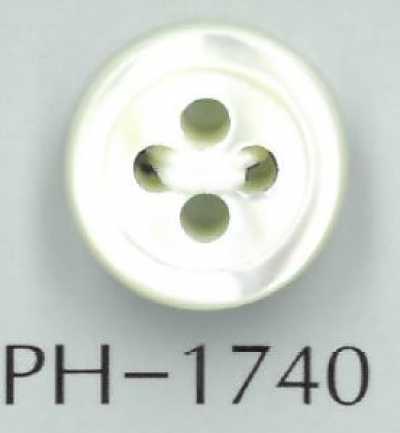
Ligne is a size unit and does not distinguish between hole structures such as two-hole, four-hole, or cat’s-eye buttons, or between shank structures such as shank buttons and tunnel shank buttons. Even within the same 20L size, the number of holes, whether there is a shank, thickness, and surface shape may differ.
Materials are also selected separately from Ligne, such as shell, real buffalo horn, nut, polyester resin, urea resin, and metal. Because dimensional tolerances, thickness, breakability, and suitability for washing or dry cleaning differ depending on the material and molding method, size alone should not be used for judgment.
Main Applications and Selection Notes
Smaller sizes are used for shirt and blouse plackets and cuffs, while larger sizes are used for jackets, cardigans, coats, outerwear, and similar items. However, the appropriate size depends on the garment design, fabric thickness, button position, and ease of fastening.
When sewing on buttons, for hole-type buttons, set the thread thickness and number of strands; for shank buttons, set whether to use a thread shank, depending on the button thickness and fabric. For buttonholes, check the pass-through performance in a sample, taking into account not only the button diameter but also thickness and roundness.
Whether washing, dry cleaning, or ironing is allowed, and under what conditions, depends on the material, coating or plating, and whether there is an adhesive part. Direct exposure to a hot iron, strong impact, and prolonged contact with chemicals may cause cracking, chipping, discoloration, or surface deterioration.
Differences from Similar Terms
“Style” may refer to a button shape, design, or a product-number classification, and has a different meaning from Ligne, which is a size unit. “mm” is a general unit of length and can be converted from Ligne.
Two-hole buttons, four-hole buttons, and cat’s-eye buttons are classified by hole shape and number. Shank buttons, tunnel shanks, and ring shanks indicate the structure of the attachment part. Ligne is specified in combination with these shape classifications.
Frequently Asked Questions
How many mm is a 20L button?
20L is approx. 12.7 mm. 1L can be converted as approx. 0.635 mm. However, because there are material and manufacturing tolerances between the nominal size and the actual measured value, please measure the actual button to be used when designing the buttonhole or checking before mass production.
Should specifications be written in Ligne or mm?
In principle, use the notation used by the trading partner or the button being used. To reduce misunderstandings, list both Ligne and mm, and also clearly state the number of holes, shank structure, material, color, thickness, and so on. Ultimately, confirm the size and fastening performance with an actual sample.
If the Ligne is the same, is the buttonhole length also the same?
Even with the same Ligne, pass-through performance changes depending on the button thickness, roundness, shank height, and material. Do not decide the buttonhole length by diameter alone; set it after checking in a sample whether it can be fastened and unfastened smoothly, including the thickness and stretch of the fabric used.