Bemberg
Bemberg is the trademark name for Cupro, a regenerated cellulose fiber made from cotton linter, used mainly as a lining material in clothing to improve slipperiness and make garments easier to put on and take off, as well as more comfortable to wear.
Contents6 sections
Definition and Overview
Bemberg is the trade name used for cupro fiber. Cupro is a regenerated cellulose fiber made from cotton linter, the short fibers left around cottonseed, and is used in linings for its smooth feel and drape.
“Bemberg” is not the material category itself but a trade name, and it is sometimes referred to as if it were synonymous with cupro. When preparing specifications or care tags, it is important to distinguish between the trade name and the fiber composition description.
Used Areas and Role
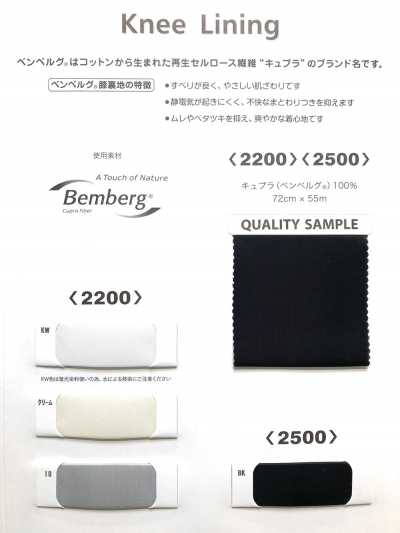
It is used for body linings and sleeve linings in jackets and coats, knee lining in pants, and linings in skirts and dresses. Its main role is to reduce friction between the outer fabric and the body, or between the outer fabric and inner layers, making garments easier to put on and take off.
In particular, sleeve linings affect how smoothly sleeves move against shirts and other layers. Knee lining may be used in specific areas to reduce snagging around the knees while easing stress on the outer fabric.
Material and Fabric Types
Cupro linings include woven fabrics such as plain weave, twill, and satin weave, and thickness, luster, durability, and sheerness vary depending on the weave, yarn thickness, and density. In addition to single-material products, there are also blended and union-fabric products with polyester and other materials.
Stretch is not determined by the fiber name alone. Some linings contain polyurethane, and some woven structures are designed to have stretch, so the required amount of stretch and recovery should be checked for each fabric.
Compatibility with Outer Fabrics and How to Choose
When the outer fabric is a material with high friction, such as wool or tweed, the slipperiness of the lining affects ease of movement when worn. On the other hand, for light, thin outer fabrics, check whether the lining is too heavy and whether its color or sheen shows through the outer side.
For stretch outer fabrics, consider a lining with stretch that does not hinder the outer fabric’s stretch. If only the outer fabric stretches and the lining does not follow, it can cause tightness when worn and stress on the seams, so it is necessary to check movement allowance through prototypes.
- Layer the outer fabric and lining to check slipperiness, sheerness, and color transfer appearance.
- Check the required stretch for each area with large movement, such as the sleeves, knees, and back.
- Confirm that it is compatible with the product’s washing method and dry-cleaning conditions.
Sewing Considerations
Because linings are often thin and slippery, pay attention to grain shifting during cutting and feed differences during sewing. To prevent seam waviness, puckering, and pulling, adjust the needle, thread, presser foot pressure, and feed amount in advance to suit the fabric.
Outer fabrics and linings may differ in their tendency to stretch or shrink. Carry out pressing and test stitching, and also check dimensional changes after washing and pressing. At cuffs and hems, it is important to provide appropriate ease so as not to restrict the movement of the outer fabric.
Frequently Asked Questions
Are Bemberg and cupro the same?
Bemberg is the trade name used for cupro fiber, while cupro is the name of the fiber. In practice, the two are sometimes referred to in a similar sense, but in material descriptions and specifications, the fiber composition and the trade name must be checked separately.
Can Bemberg-type lining be used for stretch garments?
Yes, but ordinary woven lining may not stretch as much as the outer fabric. For knits and stretch wovens, choose a lining with stretch and confirm the direction and recovery of the needed stretch. Check for tightness in the shoulders, back, and knees through prototypes.
What should be noted when using it with a thin outer fabric?
With light-colored or thin outer fabrics, the lining’s color, sheen, thickness, and seam allowances may show through the outside. Layer the outer fabric with the candidate lining and check sheerness in both natural light and indoor light, then adjust the lining color or weave as needed.