Horizontal Stripe
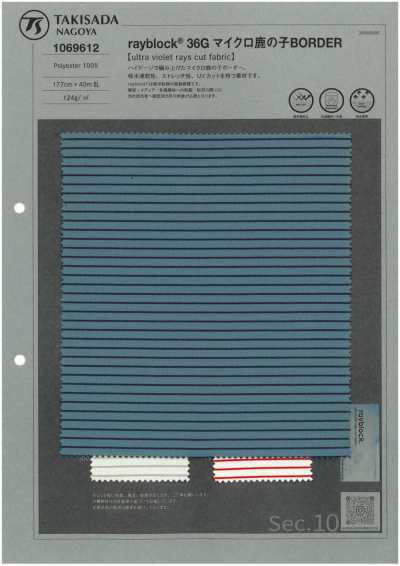
A border is a pattern expressed by repeating lines or bands of color or texture parallel to the crosswise direction of a textile, and its appearance changes depending on the width and colors of the stripes.
![NT-6040 Craft Fur [Double-Sided Eco Wool Boa Fleece]](/img/item/thumb/OKURA/1089759_t2.jpg)
Contents6 sections
Definition and Overview
Horizontal Stripe is a pattern in which stripes run continuously from selvage to selvage when a textile is viewed horizontally. It refers to horizontal stripes, as opposed to stripes running in the warp direction, but it may also be used for patterns that are called border because they appear as horizontal stripes when the garment is finished.
It is used for both woven fabrics and knits, and is expressed through the arrangement of yarn-dyed threads, changes in knit structure, changes in weave structure, or printing. For that reason, border is not the name of a material or structure, but a name for the pattern that appears on the surface.
Pattern Structure and Types
The thickness of the stripes and the spacing between them together are called the pitch, and range from narrow stripes placed closely together to wide bands arranged alternately. The impression changes greatly depending on the color combination and repeat, such as those made with a ground color and one stripe color, those using multiple colors, or those with irregular changes in width.
Yarn-dyed borders are made by weaving or knitting yarns of different colors. Borders created by piece dyeing or printing allow relatively free expression of colors and patterns. In knits, it is important to check the knitting direction and the pattern direction at the time of cutting in advance.
- Fine border: A delicate-looking pattern with narrow stripes repeated.
- Wide border: A pattern with strong presence from band-like stripes.
- Multi-border: A pattern combining stripes of multiple colors or widths.
- Panel border: A pattern in which the stripe arrangement changes depending on the position within the textile.
Main Applications and Seasonal Use
It is used for cut-and-sew items, T-shirts, knits, shirts, dresses, skirts, and more. It is often seen in casual wear, but depending on stripe width, number of colors, and the sheen or thickness of the material, it can also be used for more polished items.
Border itself has no season. Thin, breathable materials and bright color combinations are often used for spring and summer, while thicker materials such as wool blends and calm color combinations are often used for autumn and winter. Seasonal feel is determined mainly by the material and finish.
Notes on Fabric Selection and Cutting
When selecting a fabric, check the pattern direction, pitch, repeat, which is one full cycle of the pattern, and the sharpness of the color boundaries. In knits, stripes may appear slanted due to stretch, biasing, or dimensional changes after washing, so judgment should include samples and washing tests.
When matching the stripe positions on the front body, back body, side seams, sleeves, pockets, and similar parts, more yardage than for a plain fabric is usually needed. To prevent the left and right parts from shifting out of alignment, specify the reference stripe during marker making and confirm the grain and the right angle of the pattern before cutting.
Small parts such as collars, cuffs, and facings change appearance depending on whether they are cut in the same direction as the body, or intentionally in the vertical or bias direction. In the spec sheet, clearly state the pattern direction, the areas to match, and the reference line to prevent differences in understanding during sewing.
Differences from Similar Terms
Stripe can refer to striped patterns in general, but in apparel it often refers to vertical stripes. Border, by contrast, refers to horizontal stripes. However, there is also common usage based on how the item looks when worn rather than the fabric direction, so when ordering, confirm the direction with diagrams or instructions.
Check patterns are patterns in which lines running in both directions cross to form a grid. Border is basically one-direction horizontal stripes and differs in that it does not have crossing lines. If vertical lines or lines of a different structure are added to a border, check the visual appearance of the pattern individually.
Frequently Asked Questions
What is the difference between border and stripe?
Border generally refers to stripes that continue horizontally, while stripe refers to stripes that continue vertically. However, depending on the industry or product, they may be named according to how they appear when worn rather than according to the warp and weft directions of the fabric. In planning documents and purchase orders, it is safest to specify the pattern direction with arrows or diagrams.
Does border fabric require more yardage?
When matching stripes at side seams, sleeves, pockets, and similar parts, extra fabric may be needed compared with a plain fabric. The required amount varies depending on the pattern pitch, pattern shape, fabric width, and the areas being matched. Plan the marker in advance and calculate with the matching allowance included.
What should be checked when cutting border fabric?
Check whether the pattern is perpendicular to the fabric edge, whether the grain is straight, and whether the left and right body pieces will have the same stripe position. Knits may have stripes that slant due to biasing or stretch, so it is important not to pull the fabric forcefully when spreading it, and to cut after stabilizing it.
![NT-6050 Craft Fur [Double-Sided Wool Boa Fleece]](/img/item/thumb/OKURA/1089760_t2.jpg)