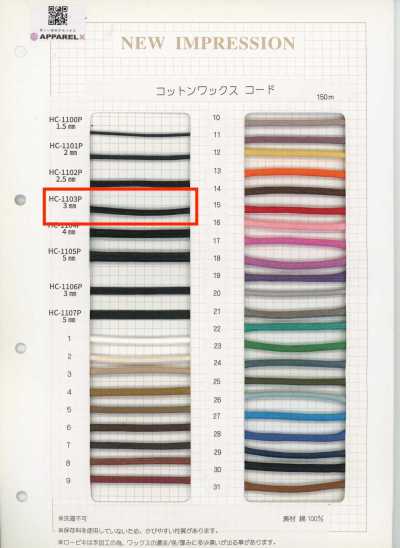
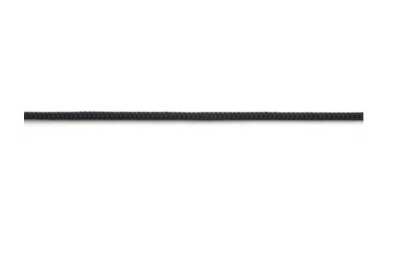
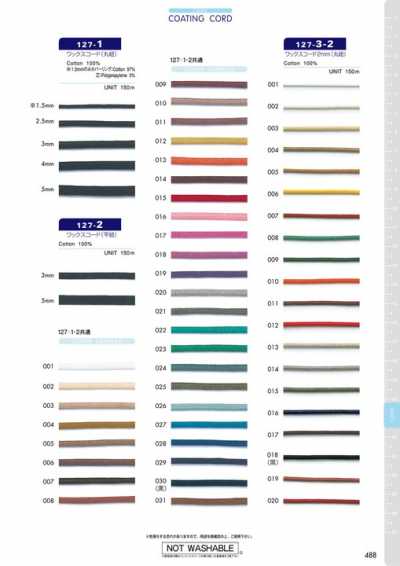
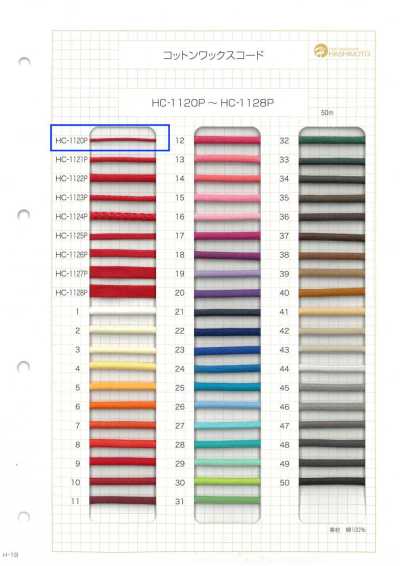
Wax Cord
Wax cord is a cord made by twisting, braiding, or plaiting yarn and then impregnating or surface-treating it with wax to adjust its firmness, slip, and texture.
Contents6 sections
Definition and Overview
Wax cord is a trim material made by applying wax treatment to a cord made from yarn such as cotton, polyester, or nylon. The treatment reduces fuzzing and gives the cord a moderate firmness and smoothness, so it is also used for applications where knots are meant to show or where it must pass through small holes.
“Wax” affects not only the surface appearance, but also the feel of the cord, how easy it is to tie, and the sensation of friction. The type and amount of wax, and whether there is a core material, vary by product, so even with the same name, the degree of firmness and tackiness is not uniform.
Materials and Structure
The yarn used as the core may be made from natural fibers or synthetic fibers, and the strength, moisture absorption, heat resistance, and dyeability differ depending on the material. Wax treatment does not indicate the material itself, so when placing an order, confirm the composition and the wax treatment condition separately.
Structures include twisted cord made by twisting multiple yarns together, braided cord made by crossing yarns, and plaited cord made by combining yarns. While many have a round cross section, some are flat, and the structure affects flexibility, resistance to flattening, and how the cut end frays.
- Twisted structure: relatively firm, and may be affected by twisting.
- Braided and plaited structures: supple and tend to follow curves easily.
- Core-insert structure: easier to keep its shape, but knots may become larger.
How Thickness Is Expressed and Main Applications
The size of wax cord is often expressed by diameter or thickness rather than width. However, flat cords may also be managed by width. When specifying it, in addition to the stated dimensions, it is important to check whether it is round or flat, how easily the cross section flattens, and whether it matches the inner diameter of the hole it will pass through.
In apparel, it is used for neck cords and decorative parts, loops, hang tags, and details that show the knot as part of the design. In bags and accessories, it is used as a drawcord for openings, around fasteners, and as a decorative cord.
- Loops and hang tag areas
- Drawcords for accessories and apparel items
- Fastening cords and decoration for bags and accessories
- Cords for connecting parts
Selection and Handling Notes
When selecting it, check the thickness, structure, material, color, and wax firmness under the actual tying method and hole conditions. For areas that are pulled strongly, confirm the required strength; for areas that touch the skin, confirm the surface firmness and feel of friction. If cord ends are used, compatibility between the cord diameter and the fixing method is also necessary.
Wax treatment reduces fuzzing, but the cut end will not always remain completely fray-free. The method for finishing the cut end varies by material, and some materials cannot be heat-processed, while in others the wax changes under heat. Before mass production, carry out trial cutting, tying, and stitching.
Washing, friction, heat, solvents, and similar factors may reduce the wax feel, cause color transfer, leave residue on surrounding areas, or change the texture. For garments that are garment-washed or applications that require frequent washing, perform washing and abrasion tests under conditions close to the finished product, and confirm the labeling information.
Differences from Similar Terms
Round cord is a general term for cords with a round cross section, regardless of whether they have wax treatment. Wax cord is a term that indicates the characteristics of surface or impregnation treatment applied to a cord, including round cord. Therefore, a round cord is not necessarily a wax cord.
Flat cord is a general term for cords with a flat cross section. Some wax cords are also flat, but the term usually refers to round products. Spindle, on the other hand, often refers to the cord used through apparel hoods or waists, while wax cord is a name that focuses on the treatment and texture.
Frequently Asked Questions
Can wax cord be used for washing apparel products?
It can be used in some cases, but the wax treatment may change with washing and friction. The result differs depending on the material, treatment method, color, and area of use, so when using it in washable products, it is important to carry out washing, abrasion, and color transfer checks in the state after sewing.
How do you choose the thickness of wax cord?
Choose it based on the inner diameter of the hole, the size of the knot, the strength required, and the presence you want to show. Even when the stated diameter is the same, the way it flattens and how easily it passes through vary depending on the structure and the amount of wax. When combining it with hardware or cord ends, always perform a pass-through test with the actual item.