Kurume Kasuri
Kurume Kasuri is a cotton textile developed in the Chikugo area in southern Fukuoka Prefecture, especially around Kurume City, that uses threads dyed in advance in different colors to create blurred patterns when woven.
Contents5 sections
Definition and Producing Region
Kurume kasuri is a kasuri woven fabric produced in the Chikugo region in southern Fukuoka Prefecture. Traditionally made primarily from cotton, it uses a yarn dyed technique in which yarn is dyed in sections before weaving, creating a distinctive blurred, faded effect along the edges of the pattern.
“Kurume kasuri” does not simply mean a textile with a printed kasuri-style pattern; it is used as a name associated with the producing region and manufacturing method. However, the scope of the production-area labeling and manufacturing process used in distribution should be confirmed with each supplier.
Technique and Texture
Kasuri is a technique in which the yarn that will form the pattern is resist-dyed by binding certain sections, then woven together after dyeing. In Kurume kasuri, warp kasuri that expresses patterns in the warp yarn is common, and the motif is formed by aligning the dyed positions during weaving.
A slight shift in weaving appears as a blurred pattern, which is a characteristic feature. Unlike uniform prints with clear outlines, it is suitable for products that make use of the handmade appearance and rustic texture. Some textiles are machine woven, and the look and production conditions are not always uniform.
- Warp kasuri: kasuri in which the pattern is expressed by dyeing the warp yarn side.
- Yarn dyed: a method of weaving after dyeing the yarn first.
- Resist dyeing: a method of preventing dye from penetrating by covering the parts that should not be dyed.
Typical Textiles and Applications
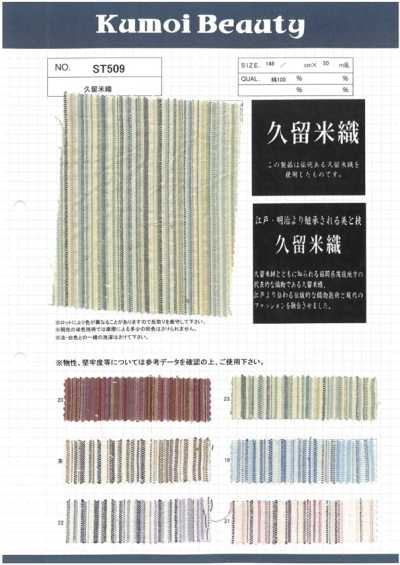
Typical examples are mainly plain-weave cotton textiles, and in addition to indigo-based styles, there are small patterns, geometric patterns, and igeta patterns made with white or colored yarn. Depending on the yarn use, density, and finishing, the lightness, firmness, and thickness vary.
In addition to kimono use as rolled fabric, it is also used for shirts, blouses, dresses, skirts, pants, haori jackets, bags, and accessories. For apparel applications, designs are considered with the pattern appearance and cutting efficiency in mind.
Points to Check When Purchasing
If regional origin is important, confirm with the supplier the basis for the Kurume kasuri labeling and where the processes such as weaving, dyeing, and finishing were carried out. Fabric labeled as "kasuri pattern" or "kasuri-style" may differ in manufacturing method or origin, so they need to be distinguished.
Fabrics that include traditional processes may have limitations in producible quantities and the continuity of colors and patterns. At the early planning stage, confirm not only the required meterage but also the minimum lot size, roll length, whether additional production is possible, delivery time, and color or pattern differences between lots.
The appearance of patterned textiles changes depending on the cutting position. Do not judge from a swatch alone; if possible, check the pattern size, pattern direction, selvage condition, grainline, and shrinkage after washing using a sample roll, and allow for extra fabric for pattern matching.
- Scope of labeling for origin and processes
- Material blend ratio, fabric width, fabric weight, roll length
- Minimum lot, whether stock support is available, lead time for additional orders
- Acceptable range for color differences, pattern misalignment, and lot variation
- Shrinkage rate, washing instructions, and test conditions before productization
Frequently Asked Questions
What is the difference between Kurume kasuri and printed kasuri patterns?
Kurume kasuri is a woven fabric associated with the origin in the Chikugo region and the kasuri technique of weaving dyed yarn to express patterns. Printed kasuri patterns are a method of adding a pattern to the surface of the textile and do not necessarily involve yarn dyeing or a specific origin. In specifications and hang tags, use the correct term after confirming the supplier’s basis for labeling.
Are there any points to watch when using Kurume kasuri in apparel products?
Confirm the pattern direction, pattern size, and the increase in fabric required for pattern matching before pattern design and cutting. In addition, because width, thickness, shrinkage, and colorfastness tendencies differ by textile, it is important to carry out sewing tests and washing tests before mass production, and to check for color transfer to accessories and seam shrinkage.
Is all Kurume kasuri handwoven?
While some Kurume kasuri make use of handwork, the weaving method and processes vary by textile and producer. Not only whether it is handwoven or machine woven, but also how the binding, resist dyeing, dyeing, weaving, and finishing processes are carried out is not uniform. Please confirm the required specifications individually with the supplier.