Tiger Stripe
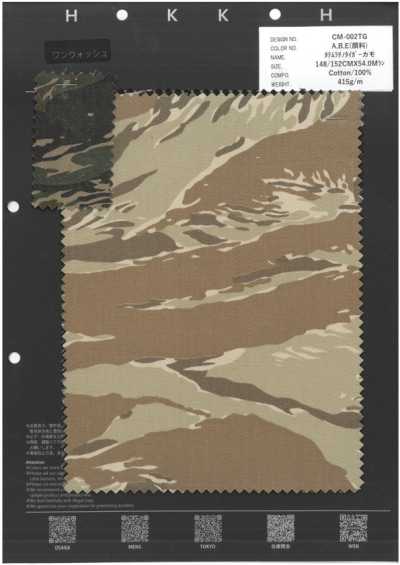
Tiger stripe is a type of camouflage pattern with a flowing direction, made by layering long, irregular lines and blotches that evoke tiger stripes.
Contents5 sections
Definition and Overview
Tiger Stripe is a camouflage pattern made by layering thin, wavy light and dark lines and irregular blotches over a base color. Unlike ordinary stripes, where bands run at regular intervals, the line width, length, and spacing vary, creating a sense of movement.
The name comes from an appearance that evokes tiger fur, but it is not an animal pattern that realistically depicts a tiger. It is not a fabric weave or material name; it is a pattern name used in prints and similar applications.
How the Pattern Developed and What It Is Called
Tiger Stripe is known as a camouflage pattern with a military origin, and in fashion it is used for military-style and outdoor-style designs. However, there are many variations in color scheme, line shape, and blotch density, so the name alone does not define the finer details of the pattern.
Common examples combine low-saturation colors such as khaki, green, brown, and black, but in modern apparel it may also be expressed in bright colors or a single color. Tiger camo is used as an abbreviation, but it is treated separately from camouflage as a general term for camouflage patterns.
- Camouflage pattern: a general term for multicolor, irregularly shaped patterns intended to blend into the natural environment.
- Digital camouflage: a camouflage pattern made up of small square forms, which looks different from the curved lines of Tiger Stripe.
- Animal pattern: a decorative pattern that represents the markings of an animal's fur or skin, which differs from camouflage in purpose and origin.
Main Uses and Seasonality
It is used for items such as shirts, pants, blousons, jackets, and bags when a casual, workwear, or outdoor look is desired. Because the pattern has a strong presence, it is suited not only to full-piece use but also to partial use on pockets, yokes, linings, and similar parts.
The pattern itself is not seasonal. In lightweight cotton fabrics and polyester materials, it may be used for spring and summer shirts and light apparel; in relatively sturdy fabrics such as twill and ripstop, it may be used for autumn and winter outerwear and bottoms.
Notes on Fabric Selection and Cutting
Even with the same Tiger Stripe pattern, suitability changes depending on the material, thickness, weave, and finishing. For shirts, lightness and hand feel are important; for bottoms and outerwear, durability and body are important. It is important to prioritize the performance required for the finished product and not choose fabric based on the pattern alone.
For patterns with a directional line flow, the specification sheet should clearly state whether the pattern direction should be aligned on the left and right body pieces and sleeves, or intentionally changed. Since cutting the fabric upside down can greatly change the appearance, the top-to-bottom direction of the roll and the cutting direction should be checked in advance.
At the seams between large parts, aligning distinctive lines and blotches creates a neat impression. On the other hand, because it is an irregular pattern, complete pattern matching may be difficult, so confirm the repeat, pattern size, and fabric width, and allow extra yardage in the marker plan.
- Check the appearance of the pattern on the left and right body pieces, front placket, pocket, and sleeves using a toile or layout before cutting.
- Decide as a design instruction whether the pocket should match the body pattern or be intentionally offset.
- For fabrics in which the pattern direction is hard to distinguish, mark the face side and top-to-bottom direction to prevent mistakes during spreading and cutting.
Frequently Asked Questions
What is the difference between Tiger Stripe and a regular stripe?
A regular stripe is basically a pattern of parallel lines continuing in a fixed direction. Tiger Stripe is made by layering wavy, elongated lines and irregular blotches, and the line width and spacing are not uniform. Its features are camouflage-like irregularity and a flowing direction.
Does Tiger Stripe fabric require pattern matching?
Whether it is necessary depends on the design and specifications, but if prominent lines shift greatly at the center front, pockets, yokes, and similar areas, the appearance will be affected. As a basic approach, align the pattern direction first, then decide which parts should match before considering the fabric consumption and cutting layout.
Can Tiger Stripe be used for summer items?
Yes. Since the pattern itself is not limited to any season, it can be used for shirts and light outer layers if you choose a thin, breathable fabric. Whether it is suitable for hot weather is judged not by the pattern but by the wearing comfort created by the material, fabric weight, weave, and finishing.