Damask
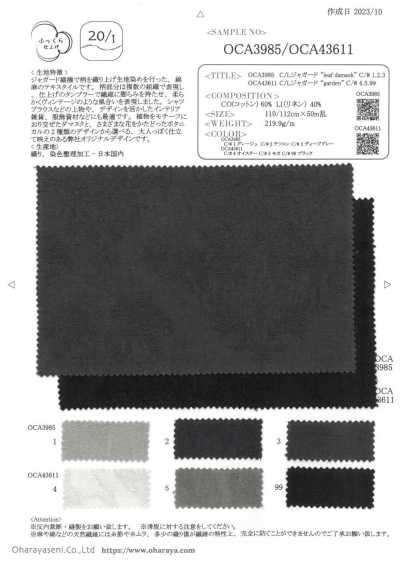
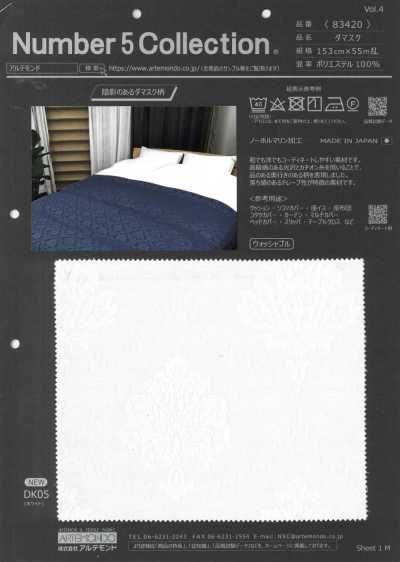
Damask is a general term for figured woven fabrics that depict floral and other motifs through sheen and shading created by differences in how the ground weave and pattern weave are constructed.
Contents6 sections
Definition and Overview
Damask is a figured textile in which the ground and pattern are woven differently by varying the float of the warp and weft. In many cases, it is based on a satin weave, with the pattern shown through differences in reflected light. Rather than laying on a pattern with color like printing, it is characterized by expression created by the weave structure itself.
It is not a material name, but a term for the structure and pattern expression. For that reason, thickness, stiffness, luster, and handling vary greatly depending on the fibers and yarn used, density, and finishing, such as cotton, linen, silk, and polyester.
Characteristics and Appearance
Although in similar colors, it has an elegant, raised appearance in which the pattern emerges depending on the viewing angle and how the light hits it. It is often used for continuous motifs such as flowers, leaves, arabesque patterns, and geometric designs, and the sense of elegance can be adjusted by the size and density of the pattern.
The satin areas readily produce a smooth luster, but in structures with long yarn floats, snagging and abrasion marks may stand out. Texture and durability should be checked not only from the material itself, but also from the structure, yarn thickness, density, and aftertreatment.
Main Applications
Taking advantage of its decorative quality, it is used for formal dresses, skirts, dresses, jackets, stage costumes, and more. Qualities with weight and firmness are also suitable for structured silhouettes and partial use. Since it ranges from light to heavy fabrics, applications should be determined according to the textile specification.
It is also used for interior applications such as curtains, cushion covers, and table linen. For apparel use, check in advance the pattern direction, repeat, and how the pattern will look after cutting, and if necessary allow extra length for pattern matching.
- For spring/summer: light varieties made with cotton or linen in a lightweight texture
- For autumn/winter and formal wear: varieties with density and fabric weight that make use of luster and dimensionality
- For interior use: varieties with performance suited to the application, such as durability and light-blocking properties
How to Choose and Handling Notes
When selecting, check the fiber blend ratio, fabric weight, thickness, drape, and pattern size, as well as how easy it is to distinguish the face and back. In apparel, the pattern may be interrupted at seams and switching points, so it is important to consider pattern placement at the patternmaking stage and confirm the appearance with a sample.
Shrinkage from washing, changes in luster, and color loss vary depending on the material and finish. Follow the care label, and perform shrinkage and washing tests in advance. For delicate structures, a laundry net may be used to reduce friction during washing, and washing inside out may be chosen.
In sewing, pay attention to slippery satin surfaces and high-density fabrics where needle holes are easy to notice. Choose a fine needle and thread suitable for the textile, and avoid unnecessary pinning. Fabrics with long floating yarns should be handled carefully so they do not snag during cutting, sewing, or wear.
Differences from Similar Terms
Jacquard is often used to refer to a mechanism for weaving complex large patterns or freely designed motifs, or to the textile woven with it. Damask often refers to a woven expression or textile in which the ground and pattern are shown by differences in luster in the same color family, and it may be woven on a Jacquard loom.
Dobby also refers to a mechanism for weaving small repeating patterns, or to the fabric made with it. Dobby is suited to relatively small geometric patterns, while damask is a term focused on pattern expression through contrast in structure. The distinction between the two can vary by region and trade usage.
Frequently Asked Questions
Is damask the same as Jacquard?
No, they are not synonymous. Jacquard mainly refers to a mechanism for weaving patterns or the fabric woven with that mechanism, while damask refers to a textile that expresses motifs through the contrast in weave structure between the ground and the pattern. Damask can be woven on a Jacquard loom.
Can damask fabric be washed at home?
It depends on the material, structure, and finishing, so it cannot be judged uniformly. Even fabrics mainly made of cotton or polyester may have delicate floating yarns or a lustrous finish. Be sure to check the care label, and before production, perform tests for shrinkage and changes in appearance.
What should be noted when cutting damask?
If the pattern has a direction or a large repeat, the pattern position must be aligned on the left and right bodice pieces and at switching sections. Allow extra yardage compared with normal. Also, fabrics with satin surfaces or long floating yarns are easily damaged, so take care to avoid snagging on the cutting table and during handling.